
A Whole-Person Perspective on Gluteal Tendinopathy.
Gluteal tendinopathy – often presenting as lateral hip pain, tenderness, and difficulty lying on the affected side – is a problem that anyone can have, but is perhaps increasingly recognized in women transitioning through perimenopause. Clinically, this condition falls under the umbrella of greater trochanteric pain syndrome (GTPS) and often reflects degenerative, not purely inflammatory, changes in the gluteus medius and minimus tendons.
From both a chiropractic and Traditional Chinese Medicine (TCM) perspective, this is not just a local tendon problem—it is a biomechanical, hormonal, and systemic condition that requires a layered treatment strategy, without which, you’ll be missing the mark.
In our clinic we’ve dealt with this condition in a variety of people, but in line with the statistics, more in perimenopausal women. For this reason, this post will lean in that direction. Approaching 25 years in practice, I have accumulated a lot of insight into this condition. I welcome you to read on for my perspective.
Understanding the Causes
Gluteal tendinopathy arises from a combination of mechanical overload and impaired tendon healing in the muscles, ligaments and tendons of the hips, pelvis and glutes. These aforementioned causes are often associated with hormonal changes, neurological control issues, strength decline, reduced recovery capacity, other coexisting conditions, changes in body fat distribution and the causes of each of these as well.
Key contributing factors:
- Hip abductor weakness → leads to compressive forces at the greater trochanter of the hip. Hip abduction moves the leg outward and away from midline.
- Pelvic instability → often tied to sacroiliac or lumbar spine dysfunction
- Repetitive strain (walking, stairs, side-lying, crossing legs)
- Altered gait mechanics (pelvic drop, crossover gait, flat feet, pigeon toe gait, foot flare, knee injuries)
Through a chiropractic lens, neurology comes first. We must ask how the brain is communicating and controlling the area of injury and surroundings, and if poorly, what is causing the stress on the nervous system and how do we fix that. We also often see joint dysfunction in the lumbar spine, sacroiliac joints, pelvis or hips driving abnormal load into the gluteal tendons, which must be investigated more. I often see this condition being influenced by flat feet as well. The interconnectivity of various body parts with the hip and gluteal complex, is profound and must be considered when strategizing the healing of this condition.
From a TCM perspective, these causes may reflect:
- Qi and Blood stagnation in the Gallbladder channel
- Underlying Liver/Kidney deficiency affecting tendon nourishment
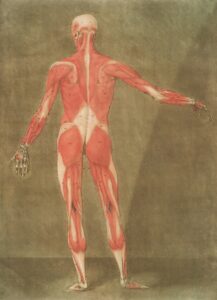
Everything is connected.
The Impact of Prior Surgery
Many patients of perimenopausal age, have had prior surgeries. Patients with a history of surgery in the low back, hip, pelvis, or lower extremities may be at significantly higher risk of developing gluteal tendinopathy.
Why?
- Scar tissue alters load distribution
- Neuromuscular inhibition (e.g., gluteal shutdown after hip or spine surgery)
- Changed biomechanics → compensation patterns overload the lateral hip
Even subtle post-surgical changes – like reduced hip extension or altered pelvic tilt – can chronically stress the gluteal tendons.
From a clinical standpoint, untreated post-surgical movement dysfunction is one of the overlooked perpetuating factors, and potentially causative factors of this condition. The impact that this dysfunction has on hip, pelvic and spinal alignment and mobility are very important to consider.
We must remember that post surgical scar tissue must be loosened up. Altered biomechanics from prosthetics must be adapted to properly. The point being, there’s often more to healing than meets the eye. Healing can be complicated and may require very well thought out solutions built on a bulletproof foundation of understanding how the body works.
Perpetuating Factors That Stall Recovery
Gluteal tendinopathy becomes chronic when certain drivers are not addressed:
- Sleeping on the affected side (compressive load all night long)
- Crossing legs or standing with “hip hanging”
- Weak hip abductors and core instability
- Poor footwear or altered gait
- Sedentary cycles alternating with bursts of activity
- Chronic inflammation or metabolic factors
- Not seeking active care to reduce pain and rebuild the function and performance of the area.
- Mental stress and associated chronic elevated cortisol levels from constant stress or “sympathetic (nervous system) overload”
You must understand, tendinopathy is not purely inflammatory—it also reflects failed healing and degenerative changes, which is why rest alone is often ineffective.
Hormones and the Perimenopausal Patient
This is where things get a bit more complicated. The most important factor is the decline in estrogen.
Estrogen plays a critical role in:
- Collagen production
- Tendon elasticity
- Tissue repair and remodeling
As estrogen levels fluctuate and decline during perimenopause:
- Tendons become less resilient and more prone to microdamage
- Healing capacity decreases
- Pain sensitivity may increase
Research in tendon biology shows that reduced estrogen is associated with:
- Disorganized collagen fibers
- Reduced tensile strength
- Increased risk of tendinopathy (similar patterns are seen in Achilles and rotator cuff tendons)
Estrogen plays a role in collagen synthesis and tendon resilience, so its reduction contributes to tendon vulnerability and slower healing.
TCM interpretation:
This phase often corresponds to:
- Kidney Yin deficiency
- Secondary Liver Blood deficiency
These patterns lead to:
- Poor tendon nourishment
- Increased stiffness and pain
Common Chinese medicine strategies:
- Acupuncture points to nourish Kidney/Liver systems
- Herbal strategies (clinically selected), often including:
- Du Zhong (Eucommia) – strengthens tendons
- Xu Duan – promotes tissue repair
- Dang Gui – nourishes blood
Acupuncture may help by:
- Increasing local circulation
- Reducing pain through endogenous opioid release
- Supporting tendon healing via improved blood flow and fibroblastic (tendon growth cells) activity
Evidence for Acupuncture for Tendinopathy
Research suggests Acupuncture may help by:
- Increasing local circulation
- Reducing pain through endogenous opioid release
- Supporting tendon healing via improved blood flow and fibroblastic activity
Clinical reports specifically show success in gluteus medius tendon conditions, with resolution of pain and restoration of function after acupuncture-based interventions
Dry needling, like Acupuncture, has also been shown to be comparable to steroid injections for hip tendon pain.
Chiropractic for Gluteal Tendinopathy
From a chiropractic standpoint, the goal is to restore proper load distribution, biomechanics and neurological control of the affected area. How does Chiropractic work and what is it?
Preferred techniques:
- Pelvic and sacroiliac joint chiropractic adjustments (different than osteopathic manipulative therapy or OMT)
- Lumbar spine mobilization
- Hip joint manipulation (when appropriate)
- Soft tissue techniques (ART, rapid release therapy, tui na, myofascial release)
These approaches:
- Improve joint mechanics
- Reduce compensatory loading
- Normalize neuromuscular control
- Reduce mental stress
- Reduce inflammation
- Improve healing capacity through better brain and nerve control
When combined with rehab, they help retrain the area and it’s nerve control to function properly, not just relieve pain.
Ancillary Modalities
As you are beginning to surmise, a multimodal approach is often most effective.
Common supportive therapies may include:
- Shockwave therapy
- Promotes tendon healing and reduces pain
- Evidence suggests improvement at 6 months
- Therapeutic ultrasound
- Enhances local tissue healing
- Electrical stimulation / electroacupuncture / Acupuncture
- Improves neuromuscular activation
- Acupuncture is more involved than dry needling and incorporates traditional Chinese medicinal theory and application to the treatment.
- Dry needling
- Targets myofascial dysfunction and tendon junctions
- Exercise rehabilitation
- Especially progressive loading of gluteal tendons

Get help today. Call Dr. Lou. (207) 774-6251
How Should a Patient Expect Their Provider To Plan Their Recovery?
EXPECTATION WARNING: This is not a quick fix condition. Patients need a clear, staged plan.
Phase 1: Calm the pain through improvement of function
- Reduce compressive loads (no side-lying on affected side)
- Begin acupuncture or manual therapy
- Modify activity
- *Remember that things hurt when underlying issues/problems exist. You can mask pain or fix the problem. The choice is yours.
Phase 2: Restore and stabilize function
- Chiropractic care for biomechanics, nerve health and communicability, muscle tone, etc. *Remember that things hurt when underlying issues/problems exist. You can mask pain or fix the problem. The choice is yours.
- Begin targeted strengthening (hip abductors, core)
- Address gait and posture
Phase 3: Reload the tendon
- Gradual progressive loading (eccentric + heavy slow resistance)
- Reintroduce functional movement
- *Remember that things hurt when underlying issues/problems exist. You can mask pain or fix the problem. The choice is yours.
Phase 4: Prevent recurrence
- Maintain strength and movement patterns
- Address hormonal and systemic factors
- Continue supportive care as needed
- Chiropractic monthly maintenance has been shown to reduce painful days by up to 13 per year.
- *Remember that things hurt when underlying issues/problems exist. You can mask pain or fix the problem. The choice is yours. IF your normal life activities caused this problem in the first place, and you go back to those activities after feeling better/healing, you will be at risk of re-causing the problem if you don’t take necessary preventive measures.
Final Thoughts
Gluteal tendinopathy in the perimenopausal woman and others is not just a tendon injury – it is a multifactorial condition shaped by biomechanics, hormones, and systemic health. It is often mistreated though, which is why I provide so many second, third and fourth opinions for people looking for help after having tried various providers without luck because their perspective was too limited.
The best outcomes come from:
- Chiropractic correction of movement and other dysfunction
- Acupuncture to support healing and modulate pain
- Progressive rehabilitation
- Hormonal and systemic balance
- Nutritional Counseling w/ Supplementation
- Maintenance of one’s body to reduce the risk of recurring causative factors
When approached holistically, by providers who see the big picture, patients not only recover – but often emerge stronger, more balanced, and more resilient than before.
Dr. Lou Jacobs has been a Chiropractor and Chiropractic Acupuncture specialist in Portland, Maine for over 24 years. He works with people of all ages and backgrounds who are looking for a dramatically different approach to healing. One that relies on the body’s innate ability to heal and regulate itself through optimized brain-body communication. His specialties include pregnant mothers, children and musicians and performing artists. These specialties translate into rock star care for everyone. If you are stuck with your low back pain progress, or progress with any other issues, call Dr. Lou for excellent listening, clear understanding, strategic action, scientific and real world expectations, and everything else that will give you the best chance of success in healing. It will be different, we promise. (207) 774-6251