
Aging Isn’t Linear: Why Your Health Can Change Faster Than You Think
I had a great, albeit brief, discussion with a local pastor recently about aging. Most people think aging happens slowly and steadily, like a gentle slope over time. But science and clinical experience is showing us something different. In our practice dealing with lots of physical and neurological wear and tear issues, this is especially clear. Aging isn’t always linear. Instead, there are periods in life where our bodies seem to change more rapidly, almost as if we’ve reached a tipping point. These cliffs that it feels we’re falling from, often appear as surprises, and we don’t feel them until we feel them. Understanding these milestones can help us shift our focus from simply living longer to living better.
The “Cliff Effect” of Aging
Recent research as well as conversations with my patietns, suggests that many of the biological changes associated with aging don’t occur at a constant rate. Instead, there are certain ages where significant changes happen over a relatively short period of time. For me it was 40, 45, 50, 52.
While everyone’s experience is unique, studies have identified noticeable shifts around the mid-40s and again around age 60. During these times, many people experience changes in:
- Muscle strength
- Joint mobility
- Balance and coordination
- Recovery after exercise
- Metabolism
- Sleep quality
- Energy levels
- Inflammation
This doesn’t mean that everyone suddenly becomes unhealthy. It simply means these are periods when the body may require more intentional care and attention. It also suggests that we look at those who care for themselves before these ages, and those who do not, and bear witness to the effects of prevention. Those who care for themselves before they start falling apart often have far fewer bumps in the road…or cliffs along the road.
Healthspan vs. Lifespan
For decades, healthcare has focused on lifespan—how many years we live.
Today, many experts are placing equal or greater importance on healthspan—the number of years we remain active, independent, and able to enjoy life.
This concept was discussed in a recent post by Robert Reich:
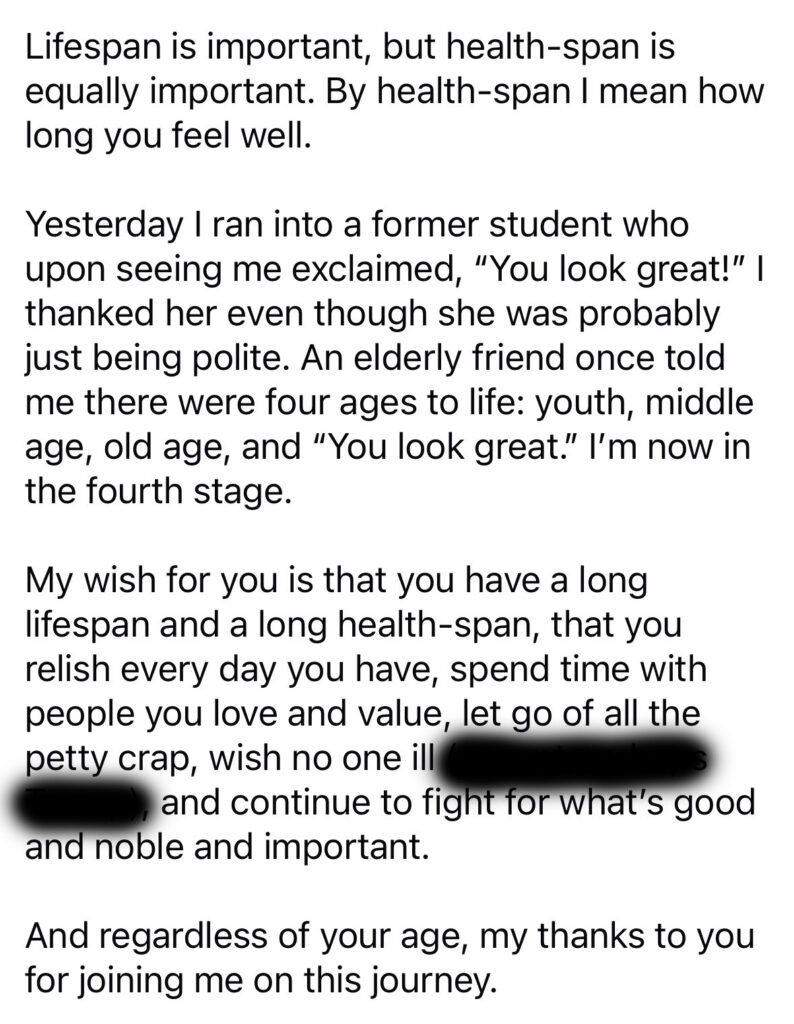
Words of wisdom on the eve of Robert Reich’s 80th birthday.
Think about it this way:
Would you rather live to 90 with the last 20 years spent struggling with pain and limited mobility?
Or would you rather stay strong, mobile, and independent for as many years as possible? Even if you only lived to 80?
That’s the goal of improving your healthspan.
Prevention Starts Before You Notice a Problem
Burn that into your skull. One of the biggest misconceptions about aging is that we should only seek help after something starts hurting. This is not only stupid, but it’s understandable that we think that way based on our health education in the U.S. We are taught that if we feel good, we are ok. If you don’t hurt, there’s no problem. If you take this medicine and feel better “you’re all set”. That is simply not true.
The reality is that many age-related changes begin years before symptoms appear.
Small declines in flexibility, balance, posture, and movement often go unnoticed until they become significant enough to interfere with daily life. For those who are really paying attention, these subtle changes are recognized as opportunities to take action for preventing problems in the future.
That’s why prevention matters.
Simple habits performed consistently can make a tremendous difference over time.
These include:
- Regular movement and exercise
- Strength training
- Good nutrition
- Quality sleep
- Stress management
- Routine health checkups
- Maintaining healthy spinal and joint function
Where Chiropractic Care Fits In
While chiropractic care cannot stop the aging process, it can help people move better, feel better, and stay active. It unequivocally affects brain function in a positive way, and helps the nervous system control, regulate, heal and adapt your body to your environment for the best possible outcomes.
Healthy movement is one of the strongest predictors of maintaining independence as we age. A healthy nervous system is crucial when controlling healthy movement. With everything being controlled by the brain and nerves that exit the sides of the spine, there is a proven, unavoidable relationship between the spine, your nervous system, and how your body functions or falls apart. Ignoring facts is ignorant, which is why the word “Ignorance” has the same root.
Regular chiropractic care may help support:
- Joint mobility
- Comfortable movement
- Posture
- Physical function
- Recovery from everyday physical stress
When your body moves efficiently, it’s often easier to stay physically active—and regular activity is one of the best investments you can make for healthy aging.
It’s Never Too Early—or Too Late (most of the time)
Whether you’re in your 30s, approaching your 50s, or well into retirement, the choices you make today influence how you’ll feel tomorrow. This is always true. The extent that the choices influence your future will depend on how much stress your body has dealt with, how you managed it, and where your “starting point” of better choices is.
You don’t have to wait until your body reaches one of these “aging cliffs” before taking action. In fact, you shouldn’t. If you wait until your falling off the cliff to try to fix your balance, it’s too late…splat!
Every healthy/unhealthy decision compounds over time. For better or worse.
Improving your health-span isn’t always about chasing “perfection”. It’s about giving yourself the best opportunity to continue doing the things you love for as long as possible.
The Bottom Line
Aging is inevitable—but how we age is influenced by many factors within our control.
Rather than waiting for pain, stiffness, or loss of function to become “normal,” consider the responsible strategy of investing in your health before problems develop.
The goal isn’t simply adding years to your life.
It’s adding life to your years.
If you’re interested in improving your nervous system health and subsequent mobility, supporting healthy movement, and staying active throughout every stage of life, our team is here to help you create a plan focused on your long term health investment portfolio.
Dr. Lou Jacobs has been a Chiropractor and Chiropractic Acupuncture specialist in Portland, Maine for over 24 years. He works with people of all ages and backgrounds who are looking for a dramatically different approach to healing. One that relies on the body’s innate ability to heal and regulate itself through optimized brain-body communication. His specialties include pregnant mothers, children and musicians and performing artists. These specialties translate into rock star care for everyone. If you are stuck with your low back pain progress, or progress with any other issues, call Dr. Lou for excellent listening, clear understanding, strategic action, scientific and real world expectations, and everything else that will give you the best chance of success in healing. It will be different, we promise. (207) 774-6251